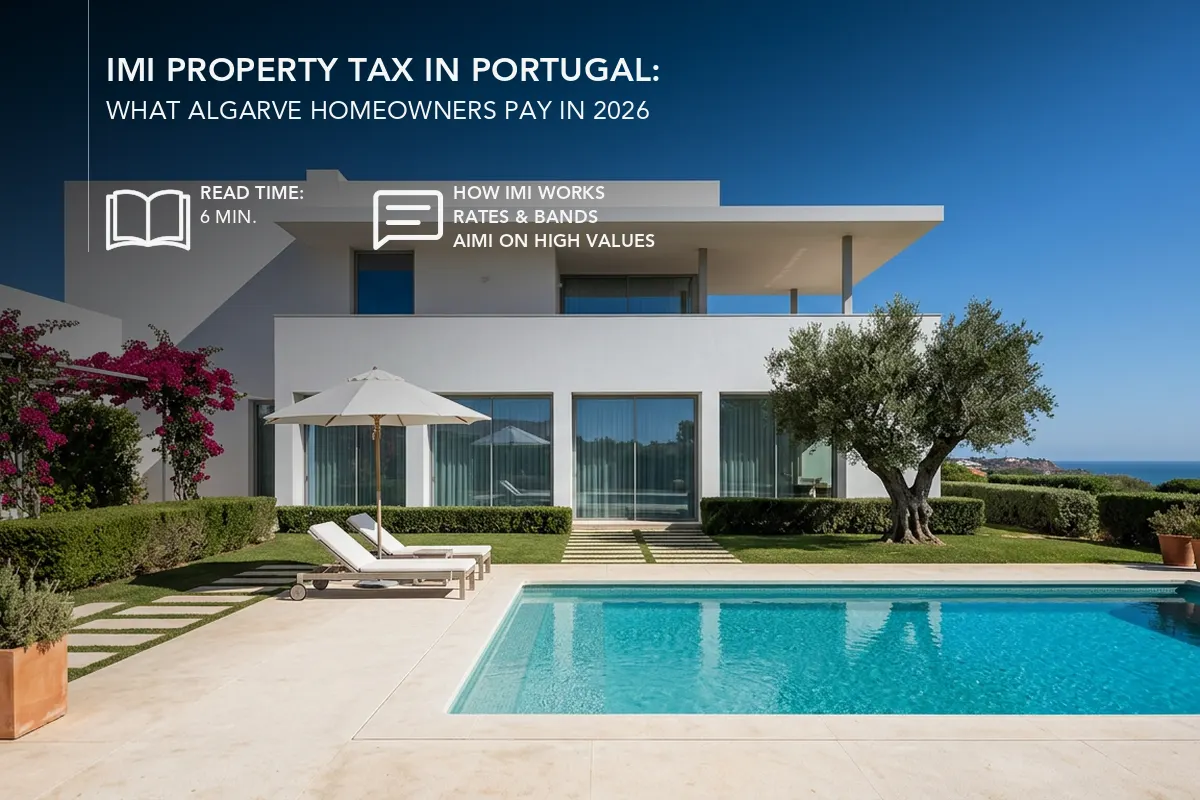
IMI Property Tax in Portugal: What Algarve Homeowners Pay in 2026
ICON Property
Every homeowner in the Algarve receives one predictable letter a year, and it comes from the Câmara Municipal. That letter is your IMI, the Imposto Municipal sobre Imóveis, Portugal's annual property tax. It is one of the most misunderstood numbers in Portuguese real estate, partly because the IMI property tax in Portugal is not a single national figure but a local rate that changes from council to council. This 2026 guide explains how IMI is calculated, what Algarve homeowners actually pay, when it is due, who is exempt, and how the separate AIMI applies to higher-value homes.
What is IMI, and how is it calculated?
IMI is an annual municipal tax charged on the ownership of property in Portugal, and it funds local services through your council. The formula is simple: your property's VPT (Valor Patrimonial Tributário, or rateable value) multiplied by the municipal rate. The detail that trips people up is that the VPT is not the price you paid. It is a tax value calculated by the tax authority using size, location, age, use and a quality coefficient, and it is usually lower, often considerably lower, than the market price of the home. Two houses that sold for the same amount can carry very different VPTs, and therefore different IMI bills.
IMI rates in 2026
For 2026, the rate bands are unchanged: urban properties are taxed between 0.30% and 0.45%, while rustic (rural) land carries a flat 0.80%. Within the urban band, each municipality sets its own rate every year, which is exactly why two identical homes in neighbouring councils can produce different bills. There is also a punitive rate of 7.5% for properties held through companies based in blacklisted offshore jurisdictions, a point worth remembering if you are considering corporate ownership.
How much IMI will you actually pay?
Take a home with a VPT of 300.000 euros. At a municipal rate of 0.30% the annual IMI is 900 euros; at 0.45% it is 1.350 euros. Because the calculation runs on VPT rather than the purchase price, the real number is often more modest than buyers expect, especially on older properties whose rateable value has not been revised. The single most useful thing you can do is check the current rate for your specific município, because it is set locally and can change from one year to the next. If you are mapping out the full picture of annual ownership costs, our guide to the true cost of owning an Algarve villa puts IMI in context alongside insurance, utilities and community fees.
When is IMI due? 2026 payment deadlines
IMI is billed in the spring for the previous year, and it can be split into instalments depending on the total amount:
100 euros or less: a single payment, due by 31 May.
Between 100 and 500 euros: two instalments, due 31 May and 30 November.
More than 500 euros: three instalments, due 31 May, 31 August and 30 November.
Non-residents pay IMI on exactly the same basis as residents, because the tax follows the property, not the owner. If you own a holiday home you will not qualify for the primary-residence relief below, so budget for the full amount. Overlooking IMI is a classic error we cover in our guide to the hidden costs of buying a home in the Algarve.
IMI exemptions
There are two main reliefs, and both are aimed at permanent residents rather than second-home owners.
The temporary exemption applies to a home used as your permanent primary residence, where the VPT does not exceed 125.000 euros and the household's taxable income is at or below 153.300 euros. It lasts three years and can be claimed up to twice in a lifetime.
The permanent exemption is aimed at low-income households, and it applies automatically. Its two thresholds are not fixed numbers: they are formulas tied to the IAS, the Indexante dos Apoios Sociais, which is revised every January. The household's gross annual income must not exceed 2.3 times the annual IAS, and the property's VPT must not exceed 10 times the annual IAS.
With the IAS set at 537,13 euros for 2026, that works out at roughly 17.295 euros of household income and roughly 75.198 euros of VPT. Because the underlying figure moves every year, always check the current values with the Autoridade Tributária rather than relying on a number you read in an older article, including this one after January. Beyond these two reliefs, some properties fall outside IMI's scope entirely.
AIMI: Portugal's tax on higher-value property
On top of IMI, Portugal levies AIMI, the Adicional ao IMI, on larger residential holdings. In a region like the Algarve, with plenty of high-value homes, it is worth understanding. AIMI is charged on the combined VPT of the residential property and building land you hold on 1 January, after a generous allowance:
Individuals: the first 600.000 euros of VPT is exempt. Above that, the rate is 0.7% up to 1.000.000 euros, 1% on the portion between 1.000.000 and 2.000.000 euros, and 1.5% on anything above 2.000.000 euros.
Married or de facto couples who opt for joint taxation: the allowance doubles to 1.200.000 euros, with the bands moving to 2.000.000 and 4.000.000 euros.
Companies: a flat 0.4% (again, 7.5% for blacklisted offshore entities).
AIMI is billed separately, in September. The key takeaway is reassuring for most buyers: because it runs on VPT and starts only above 600.000 euros per person, the great majority of single-home owners never pay it at all. It is effectively a tax on substantial portfolios and trophy homes, not on the average Algarve villa. If you are also thinking about an eventual sale, pair this with our guide to capital gains tax for non-resident sellers.
The bottom line for Algarve owners
IMI is predictable, calculated on a tax value that is usually lower than what you paid, and paid in one to three instalments across the year. For most owners it is a manageable annual cost rather than a nasty surprise, and only high-value portfolios need to think about AIMI. The smart move is simple: before you buy, ask for the property's VPT and the current municipal rate, and you will know your real IMI bill in advance.
Know your number before you buy
The best way to avoid surprises is to treat IMI as a known quantity. Ask for the VPT, check your municipality's current rate, and factor the annual figure into your budget from day one. Our team does this as standard for buyers, alongside every other running cost.
Thinking of buying in the Algarve and want the full cost picture in writing? Contact ICON Property's team for a personalized viewing tour and a clear breakdown of the taxes and running costs on any property you are considering.
Frequently asked questions
IMI on urban property is between 0.30% and 0.45% of the VPT (rateable value), set by each municipality every year. On a home with a VPT of 300.000 euros that is roughly 900 to 1.350 euros a year. Rustic land is taxed at a flat 0.80%.
It depends on the amount. Up to 100 euros is a single payment by 31 May; between 100 and 500 euros is paid in two instalments (31 May and 30 November); above 500 euros is paid in three instalments (31 May, 31 August and 30 November).
Yes. IMI is charged on the property regardless of where the owner lives, so non-residents pay it on the same basis as residents. Non-residents and holiday-home owners do not qualify for the primary-residence exemption.
AIMI is an additional tax on the combined VPT of residential property and building land above 600.000 euros per person (1.200.000 euros for a couple filing jointly). Rates run from 0.7% to 1.5%. Most owners of a single home never pay it.
Yes, a temporary three-year exemption for a permanent primary residence with a VPT up to 125.000 euros and household income up to 153.300 euros, usable twice in a lifetime. There is also an automatic permanent exemption for low-income households, where income and VPT fall below thresholds indexed to the IAS, which for 2026 work out at roughly 17.295 euros and 75.198 euros respectively.