Getting a Mortgage in Portugal as a Non-Resident: Rates, Deposits and Approval
ICON Property
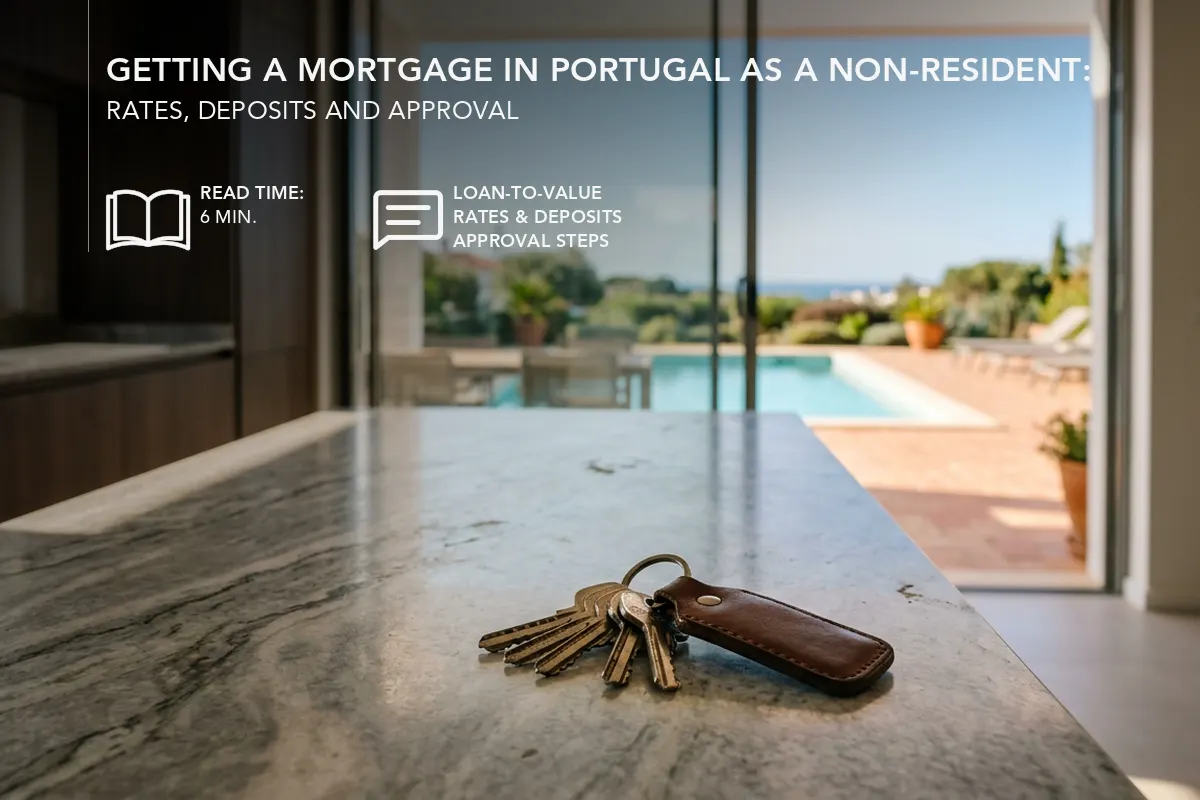
International demand for Algarve homes has stayed strong into 2026, and a growing share of buyers are no longer paying all cash. Lenders have reopened to overseas clients, and arranging a mortgage in Portugal as a non-resident is now a practical route for many international families who want to keep capital working at home while they invest on the coast. The figures in this guide are market ranges as of 2026, with the headline rate benchmarked against Banco de Portugal data, so please treat them as guidance rather than a fixed quote.
Financing a purchase from abroad is not the obstacle it once seemed. Portuguese banks actively lend to foreign buyers, and the process is well established. What changes for non-residents is the size of the deposit, the paperwork, and the terms on offer. There is also, since May 2026, a fourth thing that changed: the transfer tax a non-resident pays at completion. Understanding all four before you make an offer puts you in a far stronger position at the negotiating table.
Why more buyers want a mortgage in Portugal as a non-resident
For years the Algarve was seen as a cash market. That has shifted. With interest rates well below their recent peaks and the euro offering a natural hedge for some buyers, taking out a mortgage in Portugal as a non-resident can be smarter than liquidating investments back home. Borrowing locally also spreads currency exposure and can simplify how you hold the asset for tax and succession purposes.
There is a lifestyle logic too. Many buyers want a holiday home now and a permanent base later. A mortgage lets them secure the right property at today's prices while keeping flexibility. For a wider view of the whole journey, our overview for overseas purchasers in the region is a useful companion to this guide.
How much can you borrow? Loan-to-value and deposits
The headline figure for non-residents is loan-to-value, or LTV, the share of the property price a bank will lend. As of 2026, non-residents can typically borrow up to about 60 percent to 70 percent of the purchase price or the bank valuation, whichever is lower. That means preparing a deposit of roughly 30 percent to 40 percent from your own funds.
Residents of Portugal often access higher LTVs, sometimes up to 80 percent or 90 percent, which is why establishing residency can change the maths over time. For a first non-resident purchase, plan conservatively. A larger deposit not only unlocks the loan, it usually earns you a better rate.
The deposit is not the whole cash requirement
Remember that the deposit is only part of your upfront cash. Purchase taxes, notary and registration fees, and legal costs all sit on top, and for non-residents that side of the ledger grew in 2026.
Since 25 May 2026, under Decreto-Lei n.º 97/2026, buyers who are not tax-resident in Portugal pay a flat 7.5 percent IMT on urban residential property, in place of the progressive resident scale and with no exemptions, reductions or price threshold. In practice that means a non-resident should budget roughly 9 to 11 percent of the price in acquisition costs, against 6 to 10 percent for a resident.
Worked through on a 500,000 euro home at 65 percent LTV, the picture is this. You borrow 325,000 euros and put in 175,000 euros of deposit. On top of that you need around 37,500 euros of IMT, 4,000 euros of stamp duty, and legal, notary and registration costs, plus the mortgage's own arrangement fee and valuation. The cash you actually need at completion is therefore closer to 225,000 euros than to the 175,000 figure the LTV alone implies.
Two routes let you recover the IMT difference later: becoming a Portuguese tax resident within two years of the purchase, or letting the property residentially at up to 2,300 euros a month under a contract signed within six months and maintained for at least 36 months inside the first five years. Each carries a six-month claim deadline. Discuss both with your lawyer before you sign, because they interact with how you use the property and therefore with what you tell the bank. Our detailed breakdown of what buying really costs on the coast walks through every line item so nothing catches you out on completion day.
Rates, terms and the true cost of borrowing
Fixed, variable or mixed
Portuguese lenders offer variable rates linked to Euribor, fixed rates for a set period, and mixed products that combine the two. Mixed products have gained ground as borrowers hedge their bets.
On the level of rates, the market is well below where it was. Banco de Portugal put the average rate on new mortgage contracts at 2.91 percent in May 2026, up slightly from 2.86 percent in April. Euribor in early August 2026 sat at roughly 2.49 percent over three months, 2.72 percent over six and 2.93 percent over twelve.
Against that backdrop, a realistic planning range for a non-resident in 2026 is roughly 2.9 percent to 4 percent, depending on the lender, the term, your profile, and whether you choose fixed or variable. Non-residents are typically quoted toward the upper end, because banks price the additional risk and documentation into the spread. Variable rates move with Euribor, so they can fall or rise, while fixed rates cost a little more for the certainty they bring.
Loan terms often run up to 30 to 35 years, subject to age limits. Most banks want the loan repaid by a maximum age, frequently around 75 to 80, so older borrowers may be offered shorter terms.
Fees and insurance to budget for
Beyond the rate, budget for an arrangement or commitment fee of roughly 1 percent to 1.5 percent of the loan, and a property valuation that usually costs somewhere between 300 and 650 euros. Banks also require life insurance and buildings insurance as a condition of the mortgage, so factor those annual premiums into your running costs.
Because these charges and premiums vary between lenders, a mortgage broker who works with several banks will give you exact, comparable quotes rather than the ranges shown here.
What you need before you apply
Two items are non-negotiable prerequisites: a Portuguese tax number, known as an NIF, and a Portuguese bank account. You will need the NIF for almost every step of the purchase, and the account to receive the loan and pay the monthly instalments.
Opening both is straightforward with the right help, and it also makes currency transfers cleaner. Our guide to banking and moving money into Portugal explains how to set these up and manage exchange risk when your income is in another currency.
Banks will then ask for a familiar set of documents: passport, proof of address, recent payslips or business accounts, tax returns, bank statements, and a summary of existing loans. The self-employed and company owners should expect to provide a little more. Clean, translated, well organised paperwork speeds everything up.
The approval process, step by step
The path from enquiry to keys usually follows a clear sequence. First comes a decision in principle, where the bank reviews your income and gives an indicative amount and rate. This is worth securing before you house-hunt in earnest.
Next, once you have agreed a property, the bank commissions a valuation. The formal offer follows, setting out the rate, term, fees and insurance conditions. After you accept, the mortgage completes at the same public deed where ownership transfers.
From application to completion, allow several weeks. Timelines depend on how quickly documents are gathered and the valuation is booked, so early preparation is the single biggest factor you control.
Looking for value on the coast? Browse ICON Property's latest Algarve opportunities while your financing takes shape, so you are ready to move when the right home appears.
EU versus non-EU applicants
Nationality can affect the terms on offer. EU and EEA applicants are often assessed on a similar footing to residents in some respects, while buyers from outside the EU may be offered a lower maximum LTV or asked for extra documentation. This is a general pattern reported across the market in 2026, not a fixed rule, and individual banks set their own policies.
Worth separating clearly: the 7.5 percent IMT described above is not about nationality at all. It turns on tax residency, so an EU citizen living outside Portugal pays it just as a non-EU citizen would, while anyone already tax-resident in Portugal does not. A local broker will tell you quickly which lenders suit your nationality and income profile; your lawyer handles the residency question.
Conclusion: prepare early, buy with confidence
The Algarve remains one of Europe's most sought-after coastlines, and well-priced homes in prime pockets do not sit for long. With rates comfortably below their peak and banks lending to overseas clients, 2026 is a practical window to arrange financing and act decisively. Buyers who secure a decision in principle early, and who budget honestly for deposit, taxes, fees and insurance, are the ones who complete smoothly.
Related properties: explore our current villas and apartments across Vilamoura, Loulé, Faro and the wider Algarve that suit both lifestyle buyers and investors seeking rental income.
Contact ICON Property's team for a personalized viewing tour.
Frequently asked questions
Plan for roughly 30 percent to 40 percent of the price, because non-resident loan-to-value is typically capped around 60 percent to 70 percent as of 2026. Add taxes and fees of roughly 9 to 11 percent on top, since the transfer tax for non-residents is now a flat 7.5 percent.
Banco de Portugal put the average rate on new mortgage contracts at 2.91 percent in May 2026. A realistic range for a non-resident in 2026 is about 2.9 percent to 4 percent, fixed or variable and linked to Euribor, with non-residents usually quoted toward the upper end. Your rate depends on the lender, term and deposit.
Yes. A Portuguese tax number and a local bank account are prerequisites before a bank will complete your mortgage. Both are quick to arrange with the right support.
More than the deposit alone. On a 500,000 euro purchase at 65 percent LTV, a non-resident needs roughly 175,000 euros of deposit plus around 37,500 euros of IMT, 4,000 euros of stamp duty, legal and registration costs and the mortgage fees, so budget closer to 225,000 euros in total.
Allow several weeks from application to the final deed. The speed depends mostly on how quickly you supply documents and the bank books its valuation.
Usually yes, though early repayment terms vary by lender and by whether your rate is fixed or variable. Always check the conditions in your formal offer.