Algarve Property Market Outlook 2027: Prices, Demand and Where to Invest Next
ICON Property
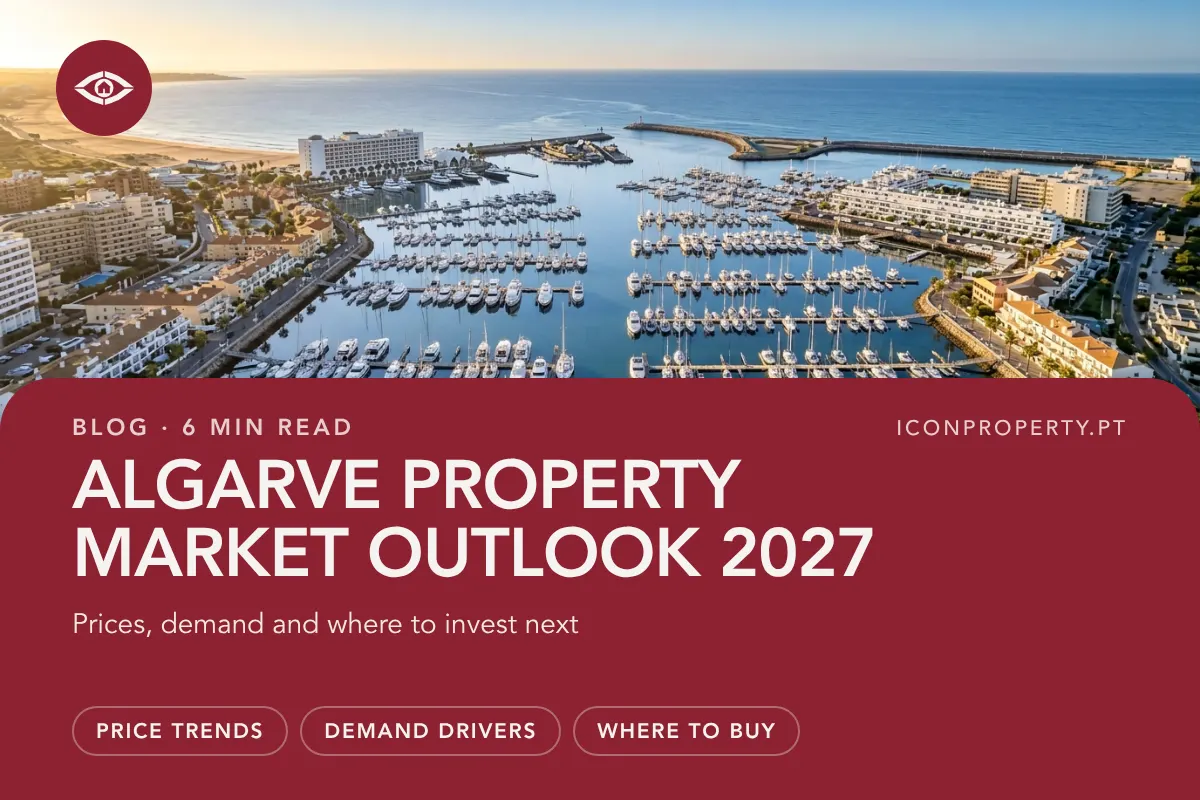
Where is the Algarve market headed after a red-hot couple of years? That is the question on every buyer's mind, and the Algarve property market outlook for 2027 is a story of strong momentum meeting a housing shortage that is finally, slowly, being answered. Prices have climbed steeply through 2025 and 2026, and while the pace is likely to moderate, the fundamentals that pushed them up have not gone away. This is a forward look at where prices, demand and opportunity are heading next, with the important caveat that no forecast is a guarantee, and every projection here should be read as a considered estimate rather than a promise.
Where the market stands going into 2027
The backdrop is one of exceptional strength. Nationally, INE's House Price Index rose 18.9% year on year in the fourth quarter of 2025, capping a full-year increase of 17.6%, a record. Prices of existing homes (18.9% over the year) outpaced new builds (14.2%). The pace has eased only slightly since: INE's latest releases show +17.8% in the first quarter of 2026 and +16.5% in the second.
In the Algarve specifically, the median bank appraisal value for apartments reached 3,010 euros per square metre in August 2026, while villas sat around 2,770 euros per square metre, well above the national medians of 2,655 euros for apartments and 1,610 euros for villas. Nationally, the overall median hit a record 2,254 euros per square metre that month. Tellingly, the Algarve also posted the largest monthly dip of any region in August, down 1.2%, an early sign that the steepest part of the climb may be behind us.
In other words, the region entered 2027 with real heat in the apartment market and steadier growth in villas. For the fuller picture of how the market behaved through the previous year, our review of real estate market trends in the Algarve in 2025 sets the scene.
The forecast for 2027
The consensus among market analysts is for continued growth, but at a calmer pace than the double-digit surges of the recent past. Analysts' forecasts made at the start of 2026 centred on roughly 7 to 8 percent for the Algarve, with a plausible range from around 5 percent in a conservative scenario to 10 percent in an optimistic one. The market has comfortably outrun those numbers so far this year, a useful reminder of how uncertain any projection is, but the expectation is still for growth to cool towards a gentler, mid-single-digit trajectory in 2027 as the market normalises. Over a longer horizon, some analysts model cumulative growth of around 30 to 45 percent across five years. Treat these as projections rather than certainties, but the direction of travel is consistent: up, but no longer overheating.
Will Algarve prices keep rising in 2027?
The short answer from the fundamentals is yes, most likely, but more slowly, and the supply picture is more nuanced than the usual shortage narrative allows.
Portugal does have a genuine housing shortage, built up over a decade of underbuilding. But supply is now responding. In 2025, 26,714 dwellings were completed nationally, the first time above 26,000 since 2011 and a fifteen-year high. More tellingly, dwellings licensed in new construction jumped 20.1% to 41,592, against 34,637 the year before. Licensing leads completions by two to three years, so the pipeline entering 2027 and 2028 is materially fatter than anything the market has seen in a long while.
That does not dissolve the shortage. Completions still run below household formation, the Algarve captures a small share of national output (the North and Centre alone took 60.2% of 2025 completions), and construction costs keep climbing. But it does argue for moderation rather than another surge. When demand stays firm and supply is finally growing, prices tend to grind higher rather than accelerate, and that is the honest reading of the bull case going into 2027.
What is driving demand
Several forces are pushing in the same direction. Foreign lifestyle demand and international migration, particularly retirement and remote-work relocation, continue to target the Algarve for its climate, safety and value. Crucially, domestic Portuguese buyers are also highly active, accounting for the vast majority of transactions, supported by incentives for younger first-time buyers such as IMT Jovem and a friendlier financing environment, with the average rate on new mortgage contracts running near 2.9% through mid-2026. Tourism underpins rental demand on top of all this. Layered over strong demand is a persistent shortage of good, walkable homes near the coast, the exact imbalance that keeps upward pressure on prices. It is the dynamic we explore in the Portugal property market and why smart money is doubling down.
Where to invest next
The clearest theme is that value is migrating away from the most expensive prime coast toward authentic, walkable towns that still have room to grow. Analysts highlight the eastern Algarve and the region's real towns as the areas positioned for the strongest gains, with places like Olhão, Faro's old town, Tavira, Portimão and Praia da Rocha, along with inland centres such as Silves and São Brás de Alportel, flagged for above-average growth. By property type, renovated apartments in walkable locations, the sort of one, two and three-bedroom units that residents and tenants actually want, are forecast to outperform larger, pricier homes. If you are weighing new-build against existing stock in these areas, our guide to off-plan versus resale is a useful next read.
The tax change every foreign buyer needs to price in
One development is no longer a risk to watch but a fact to budget for. Decreto-Lei n.º 97/2026 introduced a flat 7.5% IMT on the acquisition of urban residential property by buyers who are not tax-resident in Portugal, in force since 25 May 2026. It replaces the progressive resident scale entirely for those buyers, with no exemptions, no reductions and no price threshold.
For a market where international demand is a genuine price driver, this matters at the margin. On a 500,000 euro home a non-resident now pays 37,500 euros in transfer tax against roughly 26,240 euros for a resident buying a permanent home, so total acquisition costs run closer to 9 to 11 percent of the price rather than 6 to 10 percent. Two relief routes exist, both worth structuring in advance with a lawyer: becoming a Portuguese tax resident within two years, or letting the property residentially at up to 2,300 euros a month for at least 36 months within the first five years, each with a six-month claim deadline.
Whether this cools foreign demand meaningfully through 2027 is the open question. It is a real cost, but it lands on a market where overseas buyers are a minority of transactions and where the lifestyle case has proved resilient to previous tax changes.
The risks to watch
A balanced outlook has to name the headwinds. The most obvious is overpricing in prime coastal areas, where values have run hard and the margin of safety is thinner. Higher mortgage costs would constrain buyer power, though rates are currently well below their peak. Tighter short-term rental rules could soften investor demand in some spots, and any weakening in foreign demand, whether from the new IMT rate or from wider economic conditions, would take heat out of the top end. And the supply response described above, if it continues at 2025's pace, is itself a moderating force on prices, which is good news for buyers and a caution for anyone underwriting aggressive capital growth.
Positioned for the next cycle
The Algarve heads into 2027 in a strong but maturing position: growth is expected to continue, driven by durable lifestyle demand and a housing shortage that is only now beginning to be met, but at a more sustainable pace than the recent surge. The smart move is not to chase the hottest headline, but to buy well, in the towns and property types positioned for the next cycle, with your tax residency position settled and a clear eye on the risks. Done that way, the Algarve remains one of Europe's most compelling places to own.
Want a considered view on where your budget fits the 2027 market? Contact ICON Property's team for a personalized viewing tour, and we will help you invest where the fundamentals, not just the headlines, point.
Frequently asked questions
Most forecasts point to continued growth, but slower than the double-digit surges of 2025 and 2026, with mid-single-digit rises seen as likely as the market normalises. A persistent housing shortage supports prices, though 2025 saw completions hit a fifteen-year high and licensing rise 20%, so supply is now responding. No forecast is guaranteed.
It can be, particularly for buyers focused on value and the long term. With demand firm and financing costs well below their peak, the fundamentals remain supportive, but the froth in prime coastal areas means it pays to buy selectively, in the right town and at the right price, rather than chasing the market.
Analysts favour authentic, walkable towns with room to grow, including the eastern Algarve (Olhão, Tavira), Faro's old town, Portimão and Praia da Rocha, and inland centres like Silves and São Brás de Alportel. Renovated apartments in walkable areas are forecast to outperform.
INE's House Price Index rose 17.6% nationally across 2025, a record, and was still up 16.5% year on year in the second quarter of 2026. In the Algarve, median bank appraisals reached 3,010 euros per square metre for apartments and 2,770 for villas in August 2026, well above the national medians.
Overpricing in prime coastal areas, any rise in mortgage costs from current levels, tighter short-term rental regulation, weakening foreign demand, and the flat 7.5% IMT now payable by non-resident buyers. The growing construction pipeline is also a moderating force. A balanced buyer weighs these against the supply-demand fundamentals.
Parts of the prime coast look fully valued after several years of strong growth, but the region as a whole is still supported by a genuine housing shortage and durable demand. The value increasingly lies in the authentic towns and walkable apartments rather than the most expensive beachfront addresses.