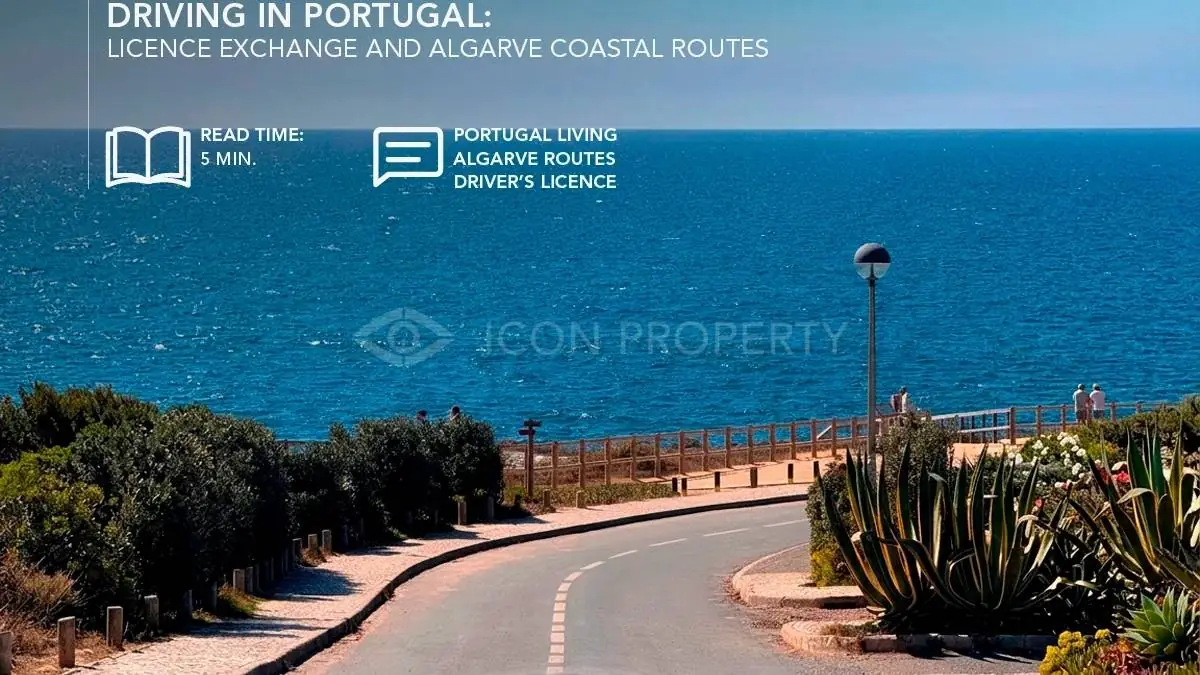
Driving in Portugal: Licence Exchange and Algarve Coastal Routes
ICON Property
Moving to Portugal means sorting out your driving licence sooner than most people expect. The rules depend on where your current licence was issued, how long you have been resident, and how old your licence is. Get this wrong and your right to drive lapses, not because anyone stops you at a checkpoint, but because your insurance and legal cover become void. This guide covers the 2026 rules for EU and non-EU residents, what Portuguese road law expects of you from day one, and three Algarve drives worth keeping for a Sunday.
What changed in 2026
The most significant procedural change for anyone exchanging a foreign licence in Portugal is that, as of 21 January 2026, all exchange applications must be submitted exclusively online through the IMT Services Portal at aminhacartadeconducao.imt-ip.pt. In-person submissions at IMT offices are no longer accepted for licence exchange. The process itself is the same; the only change is the channel.
The other significant change for Algarve residents happened a year earlier: since January 2025, the A22 motorway across the Algarve is toll-free as part of the government's SCUT programme reclassification. The gantries are still in place and still read plates, but no charge is applied. You do not need a Via Verde transponder to use the A22.
EU and EEA residents: register your address within 60 days
If your driving licence was issued by a European Union or European Economic Area country (Norway, Iceland or Liechtenstein), you can drive in Portugal using that licence until the document's expiry date. You do not need to exchange it. What you do need to do is register your Portuguese address with the Instituto da Mobilidade e dos Transportes (IMT) within 60 days of taking up residence. Registration is free and is done online through the IMT portal.
The one exception applies to lifetime licences or licences with no expiry date. If your EU licence has no expiry, you must exchange it for a Portuguese licence within two years of establishing residence.
When your EU licence expires, you renew it in Portugal rather than in the country of issue. At that point the renewal process mirrors a standard Portuguese renewal, including the medical certificate requirement.
OECD and CPLP residents: exchange within two years, or drive on without exchanging
Portugal does not require residents from OECD and CPLP countries to exchange their licence at all, provided certain conditions are met. The countries covered include the United Kingdom, United States, Brazil, Canada, Australia, Switzerland, South Korea, Japan, New Zealand, Cape Verde, Angola, Mozambique, São Tomé and Príncipe, Chile, Iceland, Israel and Turkey.
You can continue driving on your foreign licence in Portugal, even as a permanent resident, as long as all of the following apply: you are under 60 years old, your licence is valid, it was issued or last renewed within the past 15 years, and it is not suspended or revoked in either Portugal or the country of issue.
If you choose to exchange, or if you no longer meet the conditions above, you have two years from the date of taking up residence in Portugal to do so. The exchange costs €30, requires an electronic medical certificate issued by a registered doctor in Portugal (submitted directly to IMT by the doctor), and is applied for entirely online. Your original licence is returned to the issuing country's authorities, and a provisional Portuguese licence is issued while your permanent card is prepared, which takes around 60 days on average.
One practical note for UK residents: the post-Brexit arrangement means that those who established residence in Portugal before Brexit apply under EU rules rather than OECD rules. For those who arrived after Brexit, the OECD pathway applies.
Non-convention countries: exchange immediately
If your licence was issued by a country that is not party to the Geneva (1949) or Vienna (1968) road traffic conventions and does not have a bilateral agreement with Portugal, your foreign licence is not valid for driving in Portugal. You must apply to exchange it before driving. This category applies to several Asian and African countries not listed above. The online form at the IMT portal starts the process; IMT will contact you to attend a desk for biometric data collection and, in most cases, you will need to take a practical driving test (€30 per category).
Portuguese road rules that catch new residents out
• Speed limits. Urban areas are 50 km/h, rural roads 90 km/h, and motorways 120 km/h. Portuguese speed enforcement combines fixed cameras, mobile radar units and unmarked police vehicles. The use of devices that detect speed cameras is illegal and carries its own fine. Exceeding the limit by more than 60 km/h can result in immediate licence suspension.
• Roundabouts. Traffic already inside the roundabout has priority. This is the rule that new residents from the UK and Ireland most frequently misapply, as it differs from the UK's right-of-way conventions at some older roundabouts.
• Alcohol limit. The legal blood alcohol limit is 0.05 g/l. For drivers with fewer than three years of experience and for professional drivers the limit is 0.02 g/l. Fines run to €1,250 and a licence suspension of between one and twelve months.
• Reflective vest. Portugal requires a reflective vest to be kept in the passenger cabin, not the boot. If you stop on the road and exit the vehicle, you must put it on before stepping out. Keeping it in the boot is a separate fineable offence.
• Tunnels. Headlights are mandatory in all tunnels, regardless of lighting. This is one of the most commonly missed rules by new drivers in Portugal.
• Mobile phones. Use of a mobile phone while driving is prohibited unless using a hands-free system. Holding a phone at a red light is treated the same as holding it while moving.
• Tolls. While the A22 across the Algarve is now toll-free, other motorways such as the A2 (Lisbon to the Algarve) and A6 still have active tolls. These are collected at free-flow gantries that read number plates. If you do not have a Via Verde transponder, register your vehicle for EASYToll, which links your bank card to your number plate for a small setup fee and a per-transit charge. Unregistered vehicles passing under gantries accumulate toll debts that escalate into fines if not settled within five days at a Payshop or CTT.
For a full checklist of what to set up when you arrive, see our moving and relocation tips. If you are bringing an electric vehicle, our guide to bringing your EV to Portugal covers the charging network, registration and incentives. For the broader picture, the Algarve relocation checklist covers everything from NIF to health registration.
Three Algarve drives worth a Sunday
The Algarve is a region that rewards driving. The distances are short, the roads are quiet outside peak summer weekends, and the landscape changes sharply within twenty minutes in almost any direction. These three routes are chosen for scenery rather than speed.
Route 1: Lagos to Sagres along the EN268
Distance: approximately 32 km. Time without stops: 40 minutes.
Leave Lagos heading west on the EN125 and switch to the EN268 at Vila do Bispo for the final approach to Sagres. The route passes through Praia da Luz and Burgau, two whitewashed coastal villages that are worth a coffee stop, before the landscape opens up and the vegetation thins. The closer you get to Sagres, the more the terrain takes on a different character: the cliffs darken, the scrub thickens, and the Atlantic wind is present in every direction. The Fortaleza de Sagres sits at the edge of the promontory overlooking the ocean, and Cabo de São Vicente, four kilometres further north, is the south-westernmost point of continental Europe. On a clear morning, with the sun still behind you, this is as dramatic as the Algarve gets. The return drive east on the EN268 offers the same views in different light.
Route 2: Portimão to Fóia through Monchique
Distance: approximately 24 km. Time without stops: 30 minutes.
Head north from Portimão on the EN266 through the Barrocal and into the Serra de Monchique. The road climbs through eucalyptus and arbutus forest, past roadside stalls selling medronho (the local firewater distilled from arbutus berries) and handmade pottery. The town of Monchique itself is worth a stop: a hillside town with a Friday market, known for its smoked sausages and the mineral water spring at Caldas de Monchique. From Monchique, continue on the EN266-3 to the summit of Fóia at 902 metres, the highest point in the Algarve. On a clear day the view stretches to the south coast, the west coast and across to the Alentejo. This is not a coastal drive but it is the one that shows you the Algarve's other dimension, the one most visitors never find. The road is well surfaced but narrow in places; avoid it on Sunday afternoons in August when coach traffic is heavy.
Route 3: Tavira to Cacela Velha along the EN125 East
Distance: approximately 18 km. Time without stops: 20 minutes.
This is the quiet route: east from Tavira along the EN125 through the undeveloped eastern Algarve, running parallel to the Ria Formosa. Tavira itself deserves time before you leave: the Roman bridge across the Gilão river, the Igreja de Santa Maria do Castelo, and the tiled façades of the old town are the best preserved historic streetscape in the Algarve. From Tavira, head east on the EN125, turning south at the sign for Cacela Velha, a village of perhaps a hundred residents perched above the Ria Formosa lagoon. The view from the small fort and church over the sandbanks and channels is one of the least-visited and most quietly beautiful in southern Portugal. The village has one restaurant known for its oysters, which are farmed in the waters below. This stretch of the EN125, between Tavira and the Spanish border at Vila Real de Santo António, carries a fraction of the traffic of the central Algarve and crosses a landscape that has changed very little in the past fifty years.
Where ICON Property fits in
Understanding your driving licence status is one of the more time-sensitive items on the new-resident checklist, and it is one that catches people out precisely because the consequences are not immediate. The right approach depends on where your licence was issued and how long you have been resident, and getting it right from the start removes one more variable from the transition.
ICON Property advises buyers on the full picture of Algarve residency before and after purchase: from the legal and administrative steps to the practical rhythms of life in each part of the region. Browse Algarve properties or contact the team directly to talk through what arriving in the Algarve looks like in practice.
Frequently asked questions
Not necessarily, and not immediately. UK licences fall under the OECD category: if you are under 60, your licence is valid and was issued or last renewed within 15 years, you can continue driving in Portugal on your UK licence without exchanging it. If you choose to exchange, or when those conditions no longer apply, you have two years from establishing residence to complete the exchange. Apply online at aminhacartadeconducao.imt-ip.pt. The fee is €30.
Online, through the IMT portal at aminhacartadeconducao.imt-ip.pt. You will need your identification document and proof of Portuguese residence. Registration is free and should be completed within 60 days of taking up residence.
Yes. Since January 2025, the A22 across the Algarve has no active toll charge. The gantries are still in place and still read number plates, but no payment is taken or required.
Not for the A22 specifically. For other motorways in Portugal, including the A2 from Lisbon to the Algarve, you will pass through active toll gantries. A Via Verde transponder, or EASYToll registration linked to your bank card, handles these automatically. Without either, you have five days to pay accumulated tolls at a Payshop or CTT before fines begin to accumulate.
Once your online application is submitted and accepted, a provisional licence is issued. The permanent Portuguese licence typically arrives within 60 days.